How to Approach PSYC 210 Psychological Measurement and Statistics Assignments Effectively

Claim Your Discount Today
Get 10% off on all Statistics homework at statisticshomeworkhelp.com! Whether it’s Probability, Regression Analysis, or Hypothesis Testing, our experts are ready to help you excel. Don’t miss out—grab this offer today! Our dedicated team ensures accurate solutions and timely delivery, boosting your grades and confidence. Hurry, this limited-time discount won’t last forever!
We Accept








- Understanding Measurement in Psychological Research
- Descriptive Statistics for Behavioral Data
- Organizing Psychological Data Through Frequency Distributions
- Visualizing Behavioral Patterns with Graphical Techniques
- Exploring Probability in Psychological Research
- Sampling and the Representation of Psychological Populations
- Inferential Statistics and Evidence-Based Decision Making
- Hypothesis Testing in Behavioral Investigations
- Correlation and the Analysis of Psychological Relationships
- Computer-Based Data Analysis in PSYC 210
- Interpreting Statistical Output in Psychological Studies
- Applying Statistical Reasoning to Psychological Measurement
- Building a Foundation for Advanced Psychology Research
PSYC 210 Psychological Measurement and Statistics introduces students to the statistical foundations of psychological research, combining measurement principles with quantitative analysis of human behavior. Throughout the course, students work with descriptive statistics, frequency distributions, probability concepts, hypothesis testing, correlation analysis, and computer-based data analysis to evaluate psychological questions using scientific evidence. Assignments often require interpreting behavioral datasets, calculating statistical measures, creating graphical representations, and explaining research findings in the context of psychological theories. Many students find it challenging to connect statistical calculations with real-world psychological measurement and research applications. Our statistics homework help service supports students enrolled in PSYC 210 by providing expert guidance on behavioral data analysis, statistical interpretation, hypothesis testing, sampling concepts, and research methodology. Whether you are struggling with laboratory assignments, statistical software outputs, correlation studies, or measurement-related coursework, our experienced statistics experts can help you understand course concepts while delivering accurate and well-structured solutions that align with university expectations.
Understanding Measurement in Psychological Research
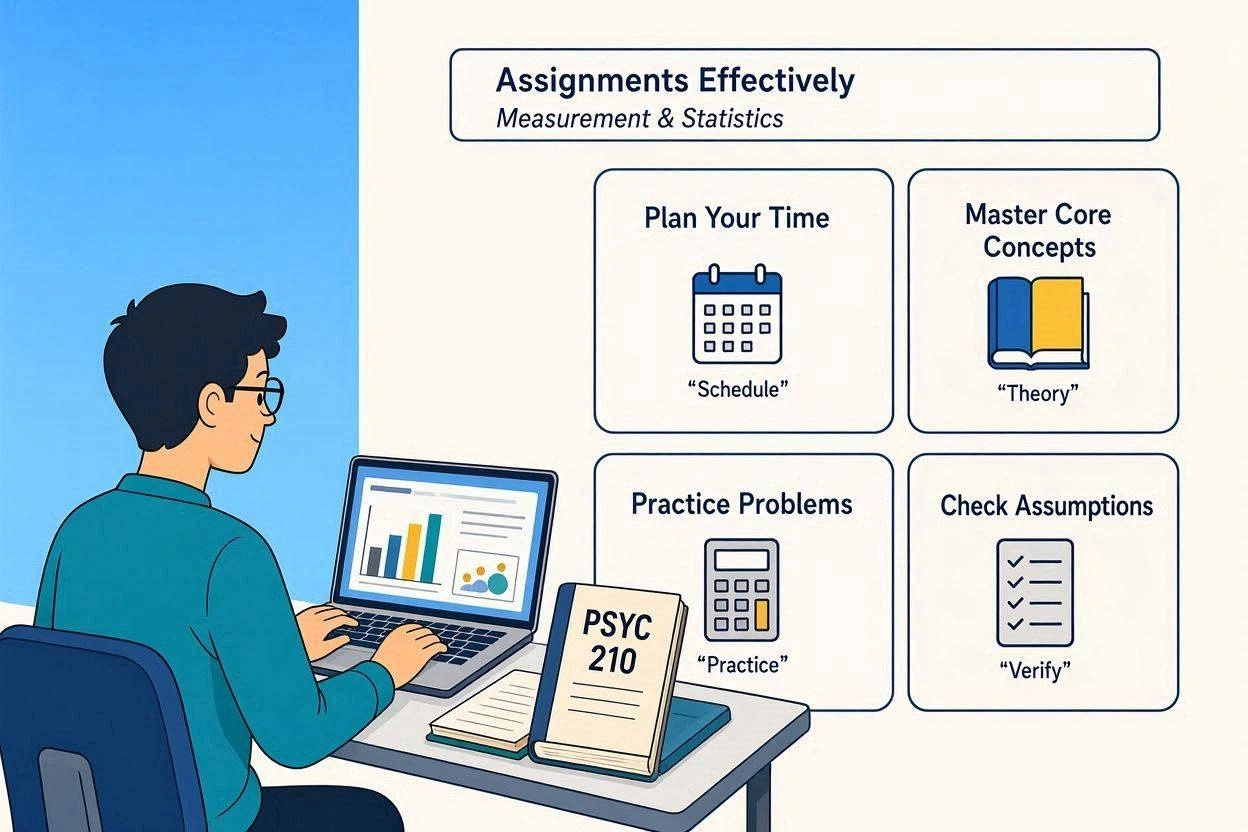
PSYC 210 Psychological Measurement and Statistics introduces students to the foundations of how psychologists transform observations of human behavior into measurable data. The course focuses on the principles used to quantify psychological constructs and apply statistical techniques to behavioral research. Students learn that concepts such as intelligence, memory, stress, motivation, and personality cannot be examined scientifically unless they are measured systematically.
A major component of the course involves understanding the relationship between psychological variables and the methods used to collect valid observations. Students examine scales of measurement, variable classification, and data collection procedures commonly used in psychological investigations. These measurement principles form the basis for every statistical analysis conducted throughout the course.
Assignments frequently require students to identify independent and dependent variables, evaluate measurement procedures, and determine whether research instruments adequately capture the psychological phenomena being studied. These tasks establish the foundation for later statistical reasoning and data interpretation.
Descriptive Statistics for Behavioral Data
One of the first major topics in PSYC 210 is descriptive statistics. Psychologists collect large amounts of behavioral information, and descriptive techniques allow researchers to summarize these observations in meaningful ways.
Students learn to calculate measures of central tendency, including means, medians, and modes. These statistics provide different perspectives on the typical performance of participants within a study. Coursework often requires students to compare these measures and determine which best represents a dataset under various conditions.
Measures of variability are equally important in psychological measurement. Standard deviation, variance, and range help researchers understand how much individual behavior differs within a population. Assignments frequently involve calculating these measures and interpreting their implications for psychological research findings.
Students also learn how descriptive statistics support the communication of research results. Rather than presenting hundreds of individual observations, researchers use summary statistics to describe overall behavioral patterns efficiently and accurately.
Organizing Psychological Data Through Frequency Distributions
Frequency distributions play a central role in PSYC 210 because they provide insight into how behavioral observations are distributed across a sample. Students learn to organize raw data into structured formats that reveal trends, concentrations, and unusual observations.
Course exercises often involve constructing frequency tables, grouped distributions, and cumulative distributions. These activities help students recognize the characteristics of different datasets and identify potential outliers.
Understanding distribution patterns is essential for later statistical analyses. Many psychological studies rely on assumptions regarding normal distributions, making it important for students to interpret the shape, spread, and location of behavioral data accurately.
By examining frequency distributions, students gain a deeper understanding of participant responses and develop the ability to evaluate whether statistical procedures are appropriate for specific research situations.
Visualizing Behavioral Patterns with Graphical Techniques
Psychological researchers frequently communicate findings through visual representations of data. PSYC 210 introduces students to graphical techniques that transform numerical information into meaningful visual displays.
Students work with histograms, bar charts, frequency polygons, and scatterplots to represent behavioral observations. Assignments may require selecting appropriate visualizations for different types of variables and interpreting the information contained within graphical displays.
Graphical analysis helps researchers identify trends that may not be immediately apparent from numerical summaries alone. Students learn how visual representations can reveal skewness, clusters, variability, and potential relationships between variables.
Because psychological research often involves communicating findings to diverse audiences, the ability to create accurate and informative visual displays becomes an essential skill throughout the course.
Exploring Probability in Psychological Research
Probability serves as the foundation of statistical reasoning in psychology. PSYC 210 introduces students to probability concepts that allow researchers to evaluate uncertainty and make evidence-based conclusions.
Students learn how probabilities describe the likelihood of events and how these concepts apply to psychological experiments. Coursework often includes calculations involving basic probability rules, independent events, and conditional probabilities.
Understanding probability enables students to appreciate why researchers rely on statistical methods rather than subjective judgment when evaluating hypotheses. Assignments frequently connect probability principles to real psychological scenarios, helping students understand how uncertainty influences scientific conclusions.
This section of the course provides the conceptual bridge between descriptive statistics and inferential statistical methods used later in psychological research.
Sampling and the Representation of Psychological Populations
Psychologists rarely have access to entire populations. Instead, they collect information from samples and use statistical techniques to draw conclusions about larger groups. PSYC 210 introduces students to sampling principles that support valid research findings.
Students examine different sampling methods and evaluate how sampling procedures affect the quality of research conclusions. Coursework often involves identifying sources of sampling bias and assessing the representativeness of research participants.
Assignments may require students to compare sampling strategies and determine which methods are most appropriate for specific psychological investigations. Through these activities, students learn how sample characteristics influence the reliability and generalizability of research outcomes.
Understanding sampling also prepares students for inferential statistics, where conclusions about populations are based on information obtained from smaller groups of participants.
Inferential Statistics and Evidence-Based Decision Making
The course introduces inferential statistics as a framework for determining whether observed differences or relationships are likely to reflect genuine psychological phenomena rather than random variation. Inferential methods are among the most important tools used by psychologists in scientific research.
Students learn the logic behind hypothesis testing and statistical decision-making. Assignments frequently involve interpreting statistical outcomes and determining whether evidence supports specific research predictions.
This portion of the course helps students move beyond describing data toward making scientifically justified conclusions. They learn how statistical evidence contributes to theory development, psychological assessment, and behavioral research.
Through practical examples, students develop an appreciation for how inferential procedures support the advancement of psychological knowledge.
Hypothesis Testing in Behavioral Investigations
Hypothesis testing is one of the defining features of PSYC 210. Students learn how psychologists formulate research questions, develop hypotheses, and evaluate evidence through statistical procedures.
Course activities typically involve distinguishing between null and alternative hypotheses and understanding the consequences of statistical decisions. Students examine the role of significance testing in determining whether observed patterns are meaningful.
Assignments often present realistic research scenarios requiring students to interpret statistical results and explain their implications for psychological theories. These exercises emphasize critical thinking rather than simple calculation.
By mastering hypothesis testing, students gain insight into how psychological researchers evaluate claims about human behavior using objective evidence.
Correlation and the Analysis of Psychological Relationships
Psychologists frequently investigate relationships between variables. PSYC 210 introduces correlation as a statistical tool for examining associations between behavioral measures.
Students learn how correlation coefficients describe the strength and direction of relationships between variables. Coursework often involves interpreting scatterplots and evaluating whether variables demonstrate positive, negative, or negligible associations.
Assignments may focus on relationships such as stress and academic performance, motivation and achievement, or personality characteristics and behavioral outcomes. These examples help students understand how correlational methods contribute to psychological research.
Students also learn the critical distinction between correlation and causation, an essential concept for evaluating research findings responsibly.
Computer-Based Data Analysis in PSYC 210
The course specifically introduces the use of computers for statistical analysis, reflecting the importance of technology in contemporary psychological research.
Students learn how statistical software assists researchers in managing datasets, performing calculations, and generating visualizations. Laboratory activities frequently require entering data, conducting analyses, and interpreting software-generated output.
Assignments emphasize understanding the meaning of results rather than simply producing numerical outputs. Students learn how technology supports statistical reasoning while recognizing the importance of critical interpretation.
Exposure to computer-based analysis also prepares students for advanced psychology courses that involve larger datasets and more sophisticated statistical techniques.
Interpreting Statistical Output in Psychological Studies
A recurring challenge in PSYC 210 is learning how to interpret statistical results within the context of behavioral research. Students move beyond calculations and focus on understanding what statistical outcomes reveal about psychological questions.
Coursework often presents research summaries requiring students to explain findings using appropriate psychological terminology. Students learn to connect numerical evidence with theoretical interpretations and practical implications.
Assignments may involve evaluating whether statistical results support specific hypotheses, discussing limitations, and identifying directions for future investigation. These activities strengthen both quantitative reasoning and scientific communication skills.
The ability to interpret statistical output accurately is essential for success in later psychology courses and research experiences.
Applying Statistical Reasoning to Psychological Measurement
Psychological measurement and statistics are closely connected throughout PSYC 210. Students learn that measurement quality directly influences the accuracy of statistical conclusions. Reliable measurements support valid interpretations, while poor measurement practices can compromise research findings.
Assignments frequently require students to consider both measurement procedures and statistical analyses simultaneously. This integrated perspective helps students understand how methodological decisions influence research outcomes.
By combining measurement principles with statistical reasoning, students develop the analytical skills needed to evaluate psychological studies critically and conduct their own investigations effectively.
Building a Foundation for Advanced Psychology Research
PSYC 210 serves as a gateway to more advanced research methods and quantitative courses within psychology. The skills developed through descriptive statistics, probability, hypothesis testing, correlation, and computer-based analysis provide the foundation for future academic and professional work.
Students completing the course gain experience interpreting behavioral data, evaluating evidence, and applying statistical reasoning to psychological questions. These competencies support success in research laboratories, upper-level psychology courses, graduate study, and data-oriented careers.
The emphasis on measurement and statistical analysis reflects the central role of quantitative methods in modern psychological science. Through sustained engagement with behavioral data, students learn how psychologists transform observations into meaningful scientific knowledge.